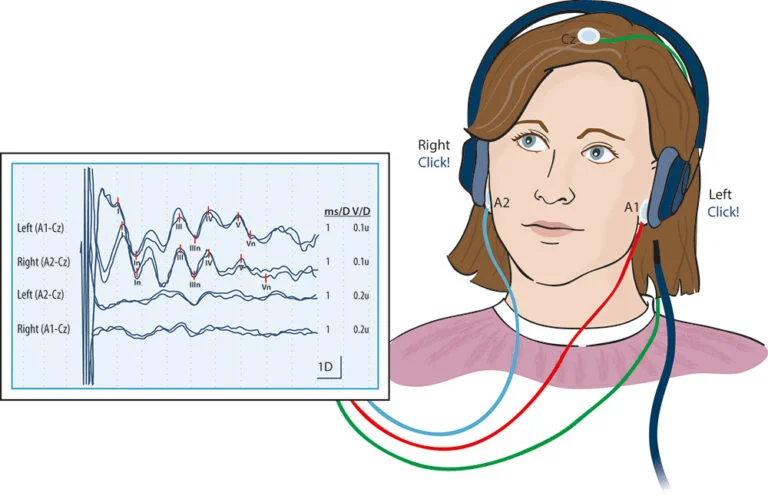
Brainstem Auditory Evoked Potentials (BAEP), also known as Brainstem Auditory Evoked Response (BAER), is a specialized neurophysiological test used to evaluate the function of the auditory nerve and brainstem pathways involved in hearing. The test measures how sound signals travel from the inner ear through the auditory nerve to the brainstem. When this pathway is affected by tumors, nerve damage, infections, or neurological disorders, signal transmission may be delayed or disrupted. BAEP provides precise information about the integrity of these pathways.
Dr. Raghu Samala utilizes Brainstem Auditory Evoked Potentials as part of a comprehensive neurological evaluation, particularly when patients present with hearing disturbances, balance issues, or suspected brainstem pathology. The test is non-invasive, safe, and especially useful in diagnosing conditions that may not be clearly visible on routine imaging alone.
Abnormal BAEP findings can be associated with a range of conditions affecting the auditory nerve or brainstem. Common causes include acoustic neuroma (vestibular schwannoma), multiple sclerosis, brainstem tumors, stroke, head injury, and certain infections. In infants and young children, BAEP may be used to assess hearing function when conventional hearing tests are not feasible.
Disorders that compress or damage the auditory nerve can interfere with the transmission of sound signals, leading to measurable delays in response times during the test.
Patients who are advised to undergo Brainstem Auditory Evoked Potentials testing may experience symptoms such as hearing loss in one or both ears, ringing in the ears (tinnitus), dizziness, balance problems, facial numbness, or unexplained neurological symptoms. In some cases, subtle hearing changes may be the first sign of an underlying neurological condition.
When hearing disturbances are persistent, progressive, or associated with other neurological signs, detailed evaluation becomes essential to determine the cause.
During a BAEP procedure, small electrodes are placed on the scalp and near the ears to record electrical activity generated in response to sound stimuli. The patient wears earphones through which clicking sounds are delivered. The electrodes record the brainstem’s electrical responses to these sounds, and the timing of each response wave is carefully analyzed.
The procedure is painless and typically completed within a short duration. Dr. Raghu Samala interprets the recorded waveforms to identify delays or abnormalities in signal transmission along the auditory pathway. When combined with clinical examination and imaging studies such as MRI, BAEP provides a comprehensive assessment of auditory nerve and brainstem function.
Treatment depends on the underlying condition identified during evaluation. If a tumor such as an acoustic neuroma is detected, surgical removal or targeted therapy may be recommended. Inflammatory or demyelinating conditions may require medical management. For stroke-related or traumatic causes, supportive neurological care and rehabilitation are essential.
Dr. Raghu Samala develops individualized treatment plans focused on addressing the root cause, preserving neurological function, and improving quality of life.
Following treatment, patients require regular follow-up to monitor hearing function and neurological stability. Additional hearing assessments or imaging studies may be recommended to track progress. In certain cases, hearing rehabilitation, balance therapy, or supportive care may be advised to optimize recovery.
Early diagnosis and appropriate intervention significantly improve long-term outcomes.
Brainstem Auditory Evoked Potentials is a safe and non-invasive procedure with minimal risks. The electrodes record electrical responses and do not deliver electrical current to the brain. Some patients may experience minor discomfort from the earphones, but the procedure itself is painless.
Delaying evaluation of hearing or neurological symptoms, however, may allow underlying conditions to progress, making early assessment important.
You should seek medical consultation if you experience persistent hearing loss, ringing in the ears, dizziness, imbalance, facial numbness, or other unexplained neurological symptoms. Early evaluation is particularly important if symptoms are worsening or affecting daily activities.
Timely diagnosis through Brainstem Auditory Evoked Potentials enables accurate identification of auditory and brainstem disorders and allows prompt treatment. If you are experiencing concerning symptoms, consultation with Dr. Raghu Samala ensures expert neurological evaluation and comprehensive care tailored to your condition.