Parkinson’s disease is a progressive neurological disorder that affects movement, coordination, and balance. It occurs due to the gradual loss of dopamine-producing nerve cells in a specific region of the brain responsible for controlling movement. As dopamine levels decrease, patients may experience tremors, stiffness, slowed movements, and difficulty maintaining balance. While medications are often effective in the early stages of Parkinson’s disease, their effectiveness may decrease over time or cause unwanted side effects. Deep Brain Stimulation (DBS) is an advanced neurosurgical treatment designed to help manage symptoms when medications alone are no longer sufficient. DBS involves the precise placement of electrodes in specific areas of the brain to regulate abnormal signals, helping patients achieve better control over their movements and improve their quality of life.
The exact cause of Parkinson’s disease is not fully understood, but it is believed to result from a combination of genetic and environmental factors. Degeneration of dopamine-producing neurons in the brain leads to the characteristic symptoms of the condition. In some individuals, genetic mutations may increase susceptibility to Parkinson’s disease, especially when there is a family history of the disorder. Environmental influences such as exposure to certain toxins, pesticides, or heavy metals may also contribute to the development of the disease. Aging is another important factor, as the risk of Parkinson’s disease increases with advancing age.
Parkinson’s disease typically develops gradually, and symptoms may vary from person to person. One of the earliest and most recognizable signs is a resting tremor, often beginning in one hand or finger. Patients may also experience muscle stiffness, slowed movements (bradykinesia), and difficulty initiating or completing routine tasks. As the condition progresses, balance problems and postural instability may develop, increasing the risk of falls. Other symptoms can include changes in handwriting, reduced facial expressions, soft or slurred speech, sleep disturbances, and mood changes such as depression or anxiety. In advanced stages, patients may also experience fluctuations in symptom control despite medication.
The diagnosis of Parkinson’s disease is primarily based on clinical evaluation and neurological examination. A neurosurgeon or neurologist carefully reviews the patient’s medical history and assesses characteristic movement symptoms such as tremor, rigidity, and slowed movement. Imaging studies such as MRI scans may be performed to rule out other neurological conditions that could cause similar symptoms. In some cases, specialized imaging tests may be used to evaluate dopamine activity in the brain. For patients being considered for Deep Brain Stimulation, additional evaluations are conducted to determine suitability, including assessments of medication response, cognitive function, and overall health.
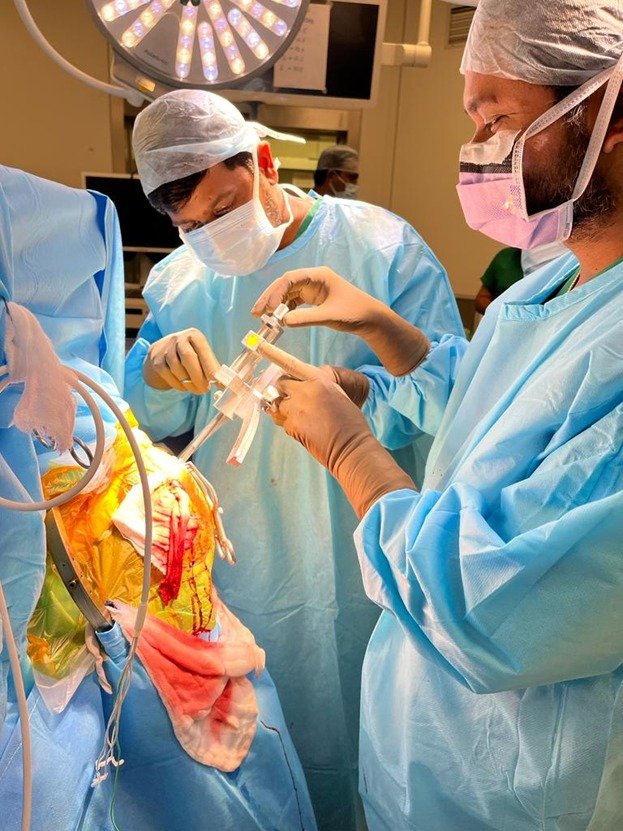
Treatment for Parkinson’s disease aims to manage symptoms and improve daily functioning. Medications that increase or mimic dopamine levels in the brain are typically the first line of treatment and can provide significant relief during the early stages of the disease. However, over time some patients may experience reduced effectiveness of medications or develop side effects such as involuntary movements. Deep Brain Stimulation is an advanced treatment option for selected patients with moderate to advanced Parkinson’s disease. The procedure involves implanting thin electrodes into targeted areas of the brain connected to a small neurostimulator device placed under the skin near the chest. This device delivers controlled electrical impulses that help regulate abnormal brain activity and reduce symptoms such as tremors, stiffness, and movement fluctuations. DBS does not cure Parkinson’s disease, but it can significantly improve symptom control and reduce dependence on medications.
After DBS surgery, patients require careful follow-up to ensure optimal results. The neurostimulator device is programmed and adjusted over several visits to achieve the best symptom control while minimizing side effects. Medication regimens may also be modified following the procedure. Rehabilitation therapies such as physiotherapy, occupational therapy, and speech therapy can further improve mobility, coordination, and communication. Regular follow-up appointments with the neurosurgeon and neurologist are important to monitor the device, adjust stimulation settings, and assess disease progression.
Like any surgical procedure, Deep Brain Stimulation carries certain risks, although serious complications are uncommon when performed by experienced neurosurgical teams. Potential risks include infection, bleeding in the brain, device malfunction, or temporary neurological side effects such as speech changes or balance difficulties. In some cases, adjustments to the stimulation settings may be required to manage side effects. Most complications can be effectively addressed with timely medical care and proper postoperative monitoring.
Patients should consult a specialist if they experience persistent tremors, stiffness, slowed movements, or difficulty with coordination and balance. Early evaluation allows for accurate diagnosis and timely management of Parkinson’s disease. Individuals already diagnosed with Parkinson’s disease should seek medical advice if medications are no longer providing consistent symptom control, if they experience severe medication side effects, or if daily activities become increasingly difficult. In such situations, advanced treatment options such as Deep Brain Stimulation may be considered to help restore better functional independence and improve overall quality of life.
“Dr. Raghu Samala provides comprehensive diagnosis and advanced treatment for a wide range of neurological diseases and disorders, ensuring personalized and compassionate care for every patient.”